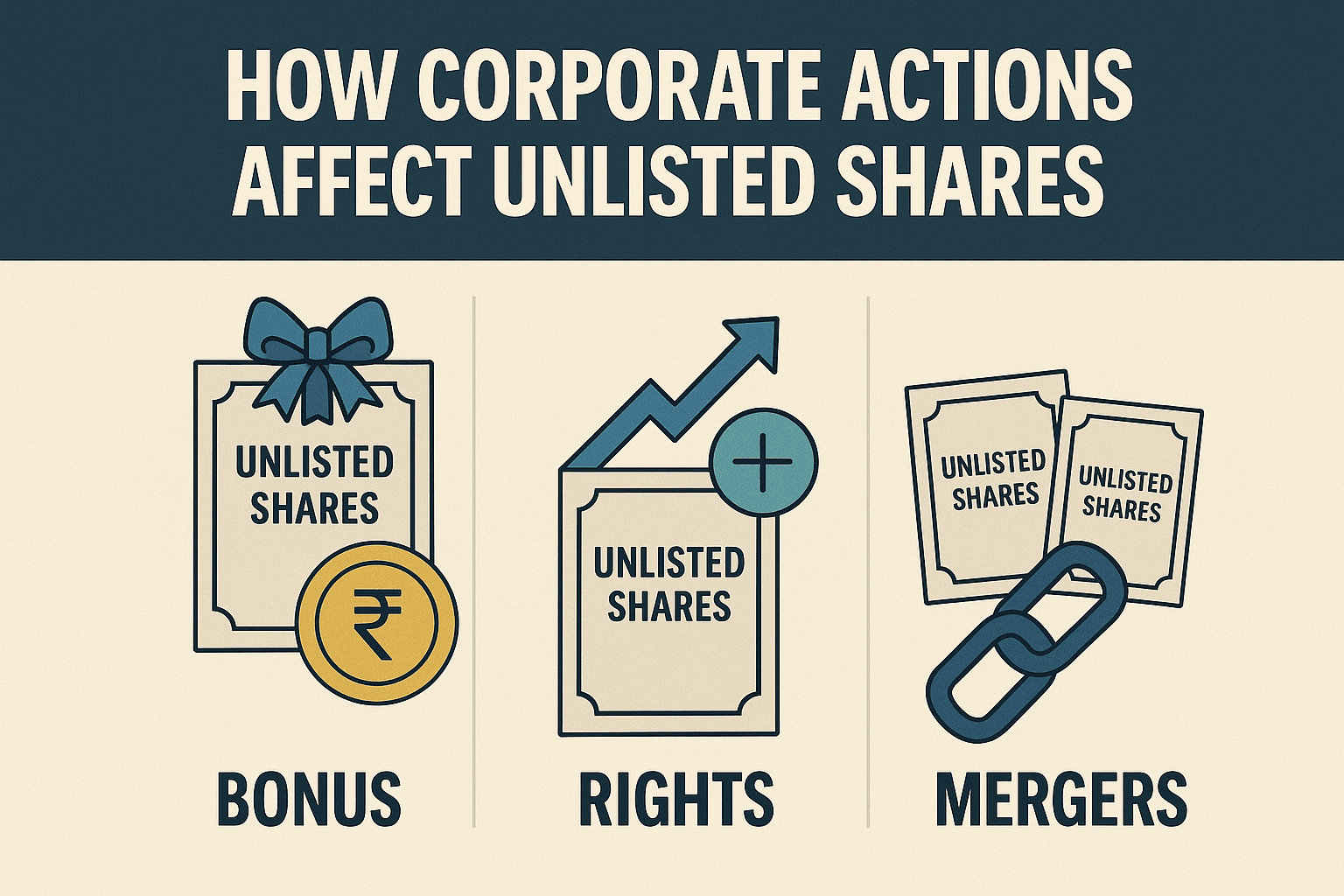
Corporate actions are deliberate moves taken by a company that directly affect its shareholders. These include actions like issuing bonus shares, conducting rights issues, entering into mergers or acquisitions, initiating stock splits, and announcing dividends. While these terms are familiar to investors in listed companies, their impact on unlisted shares is often misunderstood. In listed markets, there are clear mechanisms and regulations in place, but with unlisted shares, the landscape is far more nuanced.
Unlisted shares operate outside of traditional stock exchanges, meaning fewer regulations, less liquidity, and often limited access to real-time information. For investors and stakeholders, understanding how corporate actions influence unlisted shares is crucial for protecting their investments, ensuring compliance, and making informed decisions. The effects of these corporate moves can alter a shareholder’s stake, change the value of holdings, and even shift control within the company. So, let’s dive deep into this often-overlooked subject.
Unlisted shares are equity shares of a company that are not listed on a recognized stock exchange like the NSE or BSE. They are generally held by founders, early investors, private equity firms, or employees. These shares are traded privately through over-the-counter (OTC) deals or between investors. The lack of public listing means that price discovery is less transparent, liquidity is limited, and regulatory oversight is lighter compared to listed shares.
Understanding these differences helps investors prepare for the unique challenges that corporate actions might bring to unlisted shares.
Each type of action has a different impact on unlisted shares, making it vital for investors to understand the nuances.
Bonus shares are additional shares issued to existing shareholders without any additional cost, usually from the company’s retained earnings. It’s a way of rewarding investors while conserving cash. For example, in a 1:1 bonus issue, shareholders receive one extra share for every share they own.
In unlisted companies, bonus shares can significantly alter the capital structure. Since trading doesn’t happen in public markets, the issuance of bonus shares can dilute control or shift ownership percentages. For founders and early investors, this might mean their ownership is either enhanced or diluted, depending on how the bonus issue is structured and communicated.
Tax treatment of bonus shares varies by jurisdiction. In India, bonus shares are typically not taxed at the time of receipt. However, when these shares are eventually sold, the acquisition cost is considered nil, potentially leading to higher capital gains. For unlisted shares, tracking the original acquisition date and documenting the bonus issue properly becomes essential to avoid future tax headaches.
A rights issue allows existing shareholders to purchase additional shares at a discounted price before the company offers them to new investors. It’s a way for the company to raise new capital while giving priority to existing investors to maintain their ownership percentage.
For unlisted companies, a rights issue can be tricky. Since shares aren’t easily traded, existing shareholders must be informed directly. The valuation of the new shares also poses challenges since there’s no market price to reference. Existing investors need to conduct due diligence and assess whether the new issue is fairly priced and whether participating aligns with their investment strategy.
Investors need to evaluate these factors carefully when a rights issue is announced in an unlisted company.
When an unlisted company merges with or is acquired by another entity, shareholders’ stakes can be converted into shares of the new company, or they might receive cash or other assets in exchange. This can lead to substantial changes in the shareholder’s portfolio. The lack of transparency in valuation and negotiation processes in private deals often leaves unlisted shareholders with uncertainty about the true value of their holdings.
Since there’s no live market pricing for unlisted shares, valuation depends on financial reports, third-party valuations, and negotiations. Shareholders must pay close attention to the deal structure and seek independent valuations to ensure fairness. Often, discrepancies in valuation arise, especially when private investors and founders have differing expectations.
It’s critical for shareholders of unlisted companies to know their rights during M&A activities. Depending on the company’s articles of association and shareholder agreements, investors may have rights to approve or reject deals, rights to tag along with founders, or rights to seek fair compensation. Being proactive and understanding these rights can make a big difference in protecting one’s investment during such transitions.
A stock split increases the number of shares outstanding by issuing more shares to current shareholders. For example, in a 2:1 stock split, a shareholder with 100 shares will now hold 200 shares, while the value of each share is halved, keeping the total value of the investment unchanged. The purpose of stock splits is to make shares more affordable and attractive to investors by lowering the per-share price.
Conversely, a reverse stock split consolidates the number of shares—for instance, a 1:2 reverse split will convert 100 shares into 50 shares, doubling the per-share price. This is often done to improve the perceived value of shares or meet regulatory requirements.
For unlisted shares, stock splits and reverse splits can be even more impactful. Since there’s no daily price mechanism, shareholders rely heavily on company communication and updated shareholding certificates. A stock split can increase the number of shares in circulation, making it easier for smaller investors to participate in private placements or transactions.
On the flip side, a reverse split can consolidate ownership among fewer shareholders, often used as a strategic move before going public or seeking institutional investment. Either way, shareholders must monitor these actions closely and update their records accordingly, as incorrect shareholding documentation can lead to disputes later on.
A private tech startup preparing for Series C funding might conduct a 2:1 stock split to make shares more accessible to new investors. Conversely, a legacy family-owned business looking to simplify its cap table may execute a reverse split to reduce the number of shareholders, consolidating ownership before seeking acquisition.
Dividends are payments made by a company to its shareholders, usually from profits. They can be classified into:
In unlisted companies, dividends can serve as a critical tool for value realization since investors don’t benefit from capital appreciation via public market pricing. Regular dividends indicate a healthy, cash-generative business and can justify a higher valuation in private transactions. On the other hand, a lack of dividends might suggest reinvestment or cash flow issues.
For investors in unlisted shares, dividend announcements serve as important valuation signals. If an investor is holding shares for income, consistent dividend payment will boost their confidence and affect future investment decisions. Conversely, companies using profits for expansion instead of dividends might still offer long-term value through eventual capital gains.
Tax rules for dividends on unlisted shares can differ from those on listed shares. In India, as per the latest tax laws, dividends are added to the investor’s income and taxed according to applicable income slabs. Since unlisted dividends aren’t reported automatically via exchanges, investors must maintain meticulous records to ensure accurate tax reporting.
A buyback occurs when a company repurchases its own shares from existing shareholders, reducing the total number of shares outstanding. The goal is usually to return excess cash to investors, improve per-share financial metrics, and sometimes consolidate ownership.
For unlisted companies, buybacks often occur to provide liquidity to early-stage investors or employees with ESOPs. It also allows companies to clean up the cap table before future fundraising or listing.
In the unlisted space, a buyback is typically conducted through direct agreements with investors. It can offer a rare chance for liquidity, as unlisted shares are not easy to sell. However, the price offered during a buyback might be subject to negotiation and heavily influenced by the company's internal valuation.
If the buyback offer is at an attractive price, long-term investors may choose to cash out. On the other hand, some might prefer to hold onto their shares if they believe the company's future prospects are strong. Either way, investors should analyze the company’s motivations for buyback—whether it’s a sign of financial strength or a defensive move to maintain control.
Regulatory compliance around buybacks can be complex for unlisted entities. Companies must adhere to legal caps on buyback size, ensure adequate disclosures, and manage the process transparently. Investors should carefully review the terms of the buyback, consider tax implications, and assess how the reduced float will affect the value of their remaining shares.
A spin-off occurs when a company separates part of its business into a new, independent entity and distributes its shares to existing shareholders. A demerger typically involves a legal split of business units, creating two or more distinct companies. Both actions aim to unlock value by allowing individual business units to operate and be valued independently.
In the case of unlisted companies, spin-offs and demergers can be complex and sometimes messy. Shareholders may suddenly find themselves owning shares in a newly created unlisted entity, whose value and prospects might be unclear. Additionally, without active trading, there is limited information about the market value of the spin-off company’s shares.
For investors, a well-executed demerger can unlock hidden value, particularly if the new entity attracts investor interest or prepares for listing. On the flip side, it can complicate the investor’s portfolio and introduce new risks if the spin-off entity struggles.
An example would be a large unlisted manufacturing firm spinning off its IT services division into a new tech-focused entity. Investors in the parent company would then hold shares in both the manufacturing firm and the newly created tech business. The spin-off allows focused management and can improve value realization in future fundraising or listing plans.
Corporate actions—like bonus shares, rights issues, stock splits, mergers, and demergers—directly impact a company’s capital structure and shareholder equity. For unlisted companies, where market-driven valuation is absent, these actions demand careful recalibration of the company’s worth.
After a corporate action, the pre-action valuation is no longer valid. Let’s say a company issues a 1:1 bonus share—while each individual share’s value will decrease, the overall value of an investor’s holding may remain unchanged or slightly change, depending on market sentiment. The new share count, revised earnings per share (EPS), and projected cash flows all need to be considered to update the valuation.
Similarly, post-merger valuations must incorporate the combined entity’s financials, future prospects, and synergy potential. In spin-offs or demergers, valuation is split between the parent company and the new entity, and accurate assessment depends on standalone forecasts for each. Professional valuation services often use DCF (discounted cash flow), earnings multiples, or precedent transaction analysis to arrive at new numbers.
In unlisted companies, transparency is typically low—audited financials may not always be readily available, and market benchmarks are sparse. Post-corporate action, getting a fair valuation becomes even harder. Investors must watch out for:
To counter these risks, investors should demand full transparency during corporate actions and, where possible, seek independent valuation reports to ensure their holdings are appropriately valued.
In India, the Securities and Exchange Board of India (SEBI) plays a crucial role in governing corporate actions for listed entities. However, for unlisted companies, SEBI regulations apply only partially, mostly when companies are preparing for IPOs or when they issue securities that could eventually be traded.
For private limited companies, the Companies Act, 2013 and Income Tax Act form the legal backbone governing corporate actions. Some key points include:
Foreign unlisted companies must also comply with local regulators like the SEC in the US or FCA in the UK if cross-border elements are involved.
Compliance Requirements for Unlisted Companies
Corporate actions in unlisted companies demand compliance with:
Failure to comply can lead to disputes, tax penalties, or even legal action. Investors should actively monitor compliance and participate in voting or approvals when corporate actions are proposed.
Perhaps the biggest challenge with unlisted shares is liquidity. There is no formal marketplace where one can easily buy or sell shares. Corporate actions—such as buybacks or spin-offs—might present rare opportunities to cash out or adjust holdings, but these are few and far between. Investors need patience and a long-term horizon when investing in such shares.
Unlike public companies, unlisted firms aren’t bound to disclose material information to the public. Investors often rely on periodic updates from management or the board. After corporate actions, if communication is poor or inconsistent, investors may find it hard to accurately value their holdings or assess the true financial health of the company.
Other common issues include:
Savvy investors should insist on clear shareholder agreements that guarantee access to regular financial information, and they should stay proactive in following up with company management after major corporate events.
Before investing in unlisted shares or participating in corporate actions:
Since there’s no stock exchange for unlisted shares, investors should:
Timely information can mean the difference between making a profitable move and being caught unprepared by a surprise corporate action.
Finally, it’s always wise to engage:
Professional advice helps investors avoid costly mistakes and ensures that they’re well-positioned for both risks and opportunities following corporate actions in unlisted shares.
Corporate actions—bonus issues, rights issues, mergers, stock splits, dividends, buybacks, and spin-offs—can reshape an unlisted company’s structure, valuation, and investor returns. Unlike listed companies, unlisted firms operate in a more opaque environment with fewer regulatory checks. As a result, investors must proactively understand the mechanics of these actions and track how they affect their shareholdings.
For any investor in unlisted shares, vigilance is key. Don’t treat corporate actions lightly—these can either unlock hidden value or dilute your holdings without clear notice. Regularly seek independent valuations, demand transparent communication from company management, and be ready to consult professionals when major corporate events arise. With a disciplined approach, investors can navigate this complex space and maximize returns from their unlisted share portfolios.
Yes, in most cases, unlisted companies require board and shareholder approval through a resolution passed at the shareholders' meeting before issuing bonus shares.
Yes, dividends from unlisted shares are taxable as per the applicable income tax slab of the individual investor in India. Investors must maintain proper records for tax filing.
During a merger, shareholders of unlisted companies may receive cash, shares in the new entity, or a combination, depending on the merger terms. The impact on ownership and valuation should be analyzed carefully.
Stay connected through investor communications, AGMs, and private investor networks. Insist on clear shareholder rights and disclosure obligations through formal agreements.
Investing in unlisted shares carries inherent risks, including unpredictable corporate actions. However, with due diligence, active monitoring, and a long-term view, investors can mitigate risks and benefit from potential upside.